
Bishop High Sierra Ultra 100K
The race and aftermath

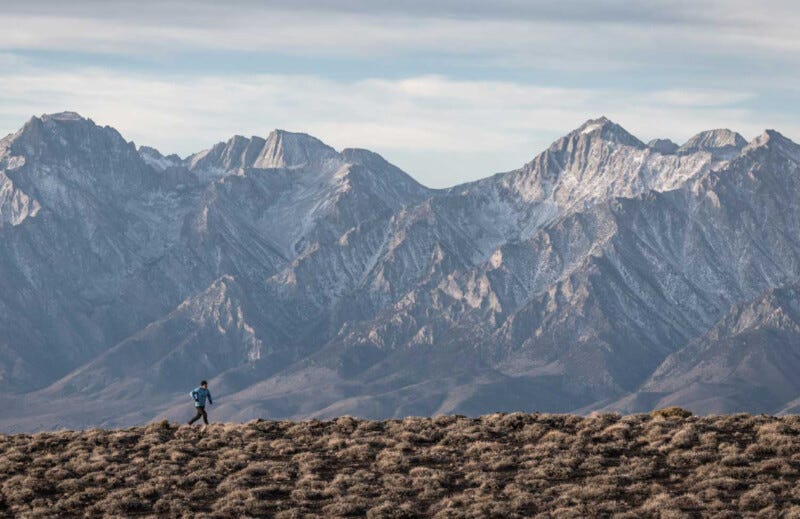
This race features several distances—20-miler, 53K, 50-miler, and 100K—that use the same course but have different turnaround points and staggered start times. Runners can also start an hour early if they believe they cannot finish before the cutoff, though this disqualifies them from podium placement. These options can be confusing for runners trying to identify who’s leading and which distance they are pacing for.
I started the race in 8th place, staying away from the leaders early on to gauge their abilities. I quickly noticed that five of the seven leaders were running faster than they should have early on, allowing me to catch the second-place runner around mile 2 and hold that position for the first six miles. At the first aid station, I refilled my water bottles and moved into second place. The jeep road we’d been running on was mostly flat with some rolling hills, but little climbing overall. Exiting the aid station, I continued on what I call douce grade for another 12 miles up a jeep road. Feeling good, I maintained a solid pace with the first-place runner, who was about a mile ahead. Around mile 8, the leaders of the 20-mile race caught me, pushing a very fast pace. After they passed, I increased my effort slightly on the long, runnable climb to stay with them until they turned back towards the finish. At about 12 miles, I faced my first unexpected problem: a cramp in my right hamstring. I noticed that stopping immediately relieved the cramp. Though a small strain I’d have to deal with for the rest of the race, it never worsened—just lingered, forcing me to slow down a little. Just before the 53K turnaround, I passed Carter Williams, an early starter I met while volunteering at Tahoe 200 last year. He’s 68 but looks much younger. We chatted for a few minutes before I headed up the hill to the first aid station, where I picked up a drop bag since I was running with a small pack. I resupplied with carb drinks and gels, then continued climbing into the Sierras toward the out-and-back section. At mile 20, after the out-and-back, I faced my first significant downhill, which bothered my hamstring. The next 15 miles comprised the second out-and-back, with a couple of aid stations, mostly climbing then descending. The hamstring pain came in waves, but I kept running for most of it despite some discomfort. Ben Tedore, the leader, was about two miles ahead for the entire race. As I turned back, the longest downhill began—roughly 20 miles, mostly downhill or flat. The increasing heat made running more difficult. Around mile 36, I tripped on a pine cone with my injured right leg, falling onto my left knee. Luckily, after walking for a while, I saw the wound wasn’t as bad as it looked. Most runners heading uphill were power hiking, so catching up was unlikely. My focus shifted to catching first place, but Ben’s strength and my hamstring’s limitations made that difficult. At mile 48, I reached the last aid station, less than three miles from the finish. The 100K route included another out-and-back section, which I hadn’t anticipated. This 12-mile stretch was steep both up and down, with no flat terrain, and had some of the race’s toughest climbs. As I descended toward the finish, I encountered the 3rd-5th place runners, who looked exhausted. With third place about four miles behind and less than 10 miles remaining, I entered cruise mode. At the final aid station, less than three miles from the finish, I met Todd, a Tahoe 200 volunteer, and his dog Elvis. Since winning was no longer possible, I spent ten minutes chatting with Todd about the upcoming Tahoe 200. The finish for these small local races is usually quiet—just a few volunteers clapping you over the line—and this race was no exception.
During a race, I never sit down because I tend to stiffen up and pay the price. After finishing, I got into my truck to head back to my hotel, ready to enjoy what always follows. There’s no real way to explain what happens once you stop running and become idle, but let’s just say it’s not enjoyable. Even stepping onto a sidewalk curb becomes a challenge, as I have to decide if I can do it. No amount of stretching or recovery tools can ease the pain that arrives over the next few days. Despite that, I felt pretty good overall, except for my hamstring, and I learned some lessons that will be useful for Tahoe. For this race, I relied solely on gels for fueling—the longest distance I’ve tried doing that—and I experienced some stomach issues, though they were manageable. Finishing second exceeded my expectations, and I’m glad I made it through.

